How To Polish Concrete Floors: A Complete Guide
Concrete polishing is a multi-stage diamond grinding process that transforms raw or worn concrete into a smooth, light-reflective surface. The work progresses through sequential grit stages, moving from coarse cuts to fine finishing passes. Garage Floors 4 Less Edmonton installs polished concrete for residential basements and commercial spaces across Edmonton, St. Albert, and Sherwood Park.
After years of working with concrete floors across Edmonton, one thing stands out: most homeowners who try this as a DIY project underestimate the equipment. Not the concept. The concept is learnable. But the gap between a consumer floor sander and professional diamond tooling shows clearly in the result.
What You'll Need Before You Start
Polished concrete requires specialised equipment that most rental yards carry only partially.
- Heavy-duty planetary grinder (60–250 lbs) for flat, consistent contact
- Diamond tooling in sequential grits: metal-bond segments from 30/40 through 150, then resin-bond pads at 400, 800, 1500, and 3000 grit
- Concrete densifier, a liquid silicate hardener applied mid-process to chemically harden the slab
- Dust shroud or wet-dry vacuum rated for concrete dust, a genuine respiratory hazard
- Straightedge or surface gauge to catch high and low spots before grinding starts
The planetary grinder is the sticking point. It's significantly heavier than standard floor tools, requiring a dedicated power supply and multiple calibration passes. Professional concrete polishing in Edmonton includes all equipment as part of the installation.
The Concrete Polishing Process, Step by Step
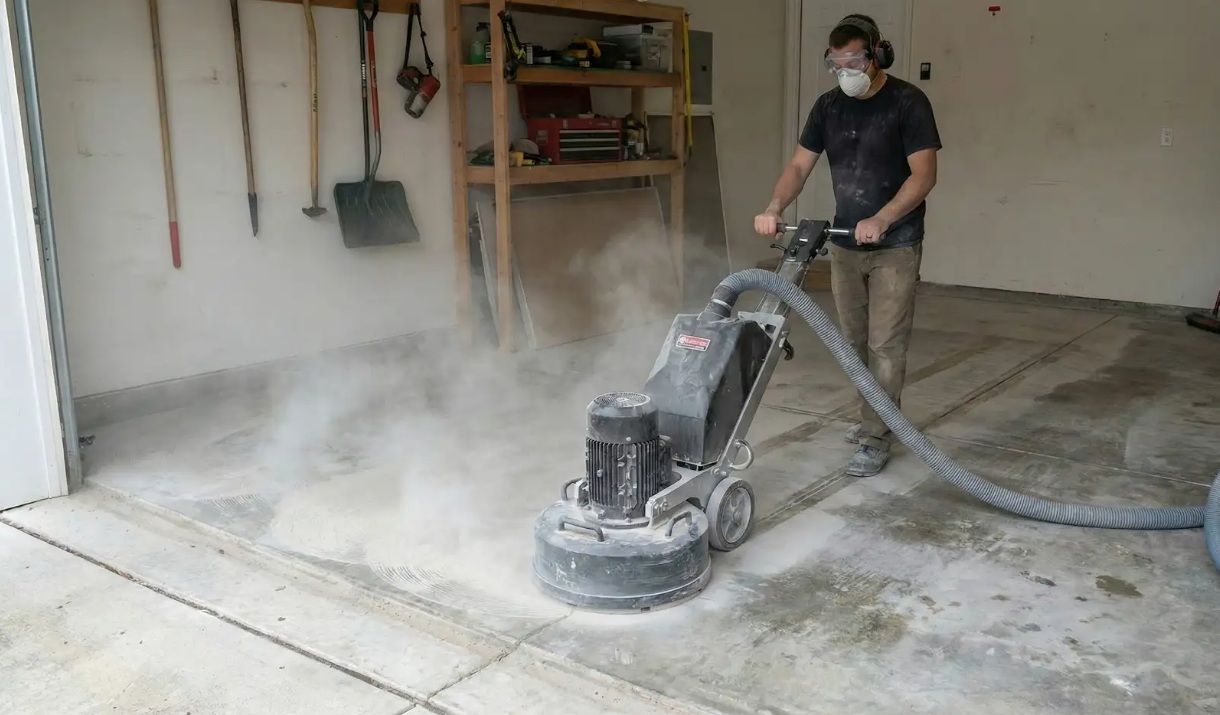
The sequence moves in one direction: coarser abrasives remove material, finer ones refine it. Skipping grits leaves scratch patterns in the final finish.
Step 1: Prepare the slab
Repair cracks and spalling before grinding. In Edmonton, freeze-thaw cycling stresses slabs from October through April; use a semi-rigid filler that moves with the concrete, not a rigid compound that re-cracks.
Step 2: Coarse grind
Start with 30 or 40 grit metal-bond tooling to remove contamination, old coatings, or a thin layer of the concrete matrix. Overlap passes at 50% to prevent grind lines.
Step 3: Refine progressively
Work through 80 and 150 grit, vacuuming between passes. At 150 grit, the surface shifts from visibly ground to uniformly matte.
Step 4: Apply densifier
At the 150–400 grit transition, apply a liquid silicate densifier and let it fully cure. Without it, fine polishing produces a flat haze instead of polished concrete’s genuine sheen.
Step 5: Fine polish and seal
Move to resin-bond pads and work through 400, 800, 1500, and 3000 grit. Residential basements typically finish at 800 or 1500 grit. Apply a penetrating sealer: road salt tracked through Edmonton garages over the extended winter season attacks unsealed concrete.
Where Edmonton Homeowners Run Into Trouble
The steps are learnable. Judgment calls are where results diverge.
Edmonton's temperature swings—from deep winter cold to summer heat—create thermal movement in slabs. Floors polished without crack repair or densification can develop micro-fractures within a few seasons. Basements in older St. Albert and Sherwood Park neighbourhoods frequently carry moisture issues that don't surface until grinding begins.
Professional installation includes moisture testing before work begins, protecting the surface from vapour transmission problems. Garage Floors 4 Less Edmonton handles crack repair as part of preparation, preventing minor cracks from widening with every freeze-thaw cycle.
DIY polishing works on slabs in good condition. If moisture concerns, coating failures, or significant cracking are present, get a professional assessment first.
Frequently Asked Questions
Can you polish a concrete garage floor in Edmonton?
Polishing a garage floor is possible in Edmonton, though garages present specific challenges. Road salt, vehicle traffic, and temperature swings require a durable sealer to protect the finish. Many Edmonton garage slabs benefit from a moisture assessment, since vapour transmission issues should be addressed before polishing begins.
How long does polishing a concrete floor take?
A standard residential basement of 500–800 square feet takes one to two days professionally, covering preparation, grit sequencing, densification, and sealing. DIY timelines run longer due to the learning curve. Garage Floors 4 Less Edmonton completes most polished concrete projects in a single day.
What's the difference between polished concrete and a concrete coating?
Polished concrete works within the existing slab, grinding and hardening the surface to produce a reflective finish. A coating system adds a new material layer over the concrete. Polished concrete suits residential interiors and commercial spaces across the Edmonton metro, while coatings are preferred in garages where chemical resistance is the priority.
Polish It Right or Get It Assessed First
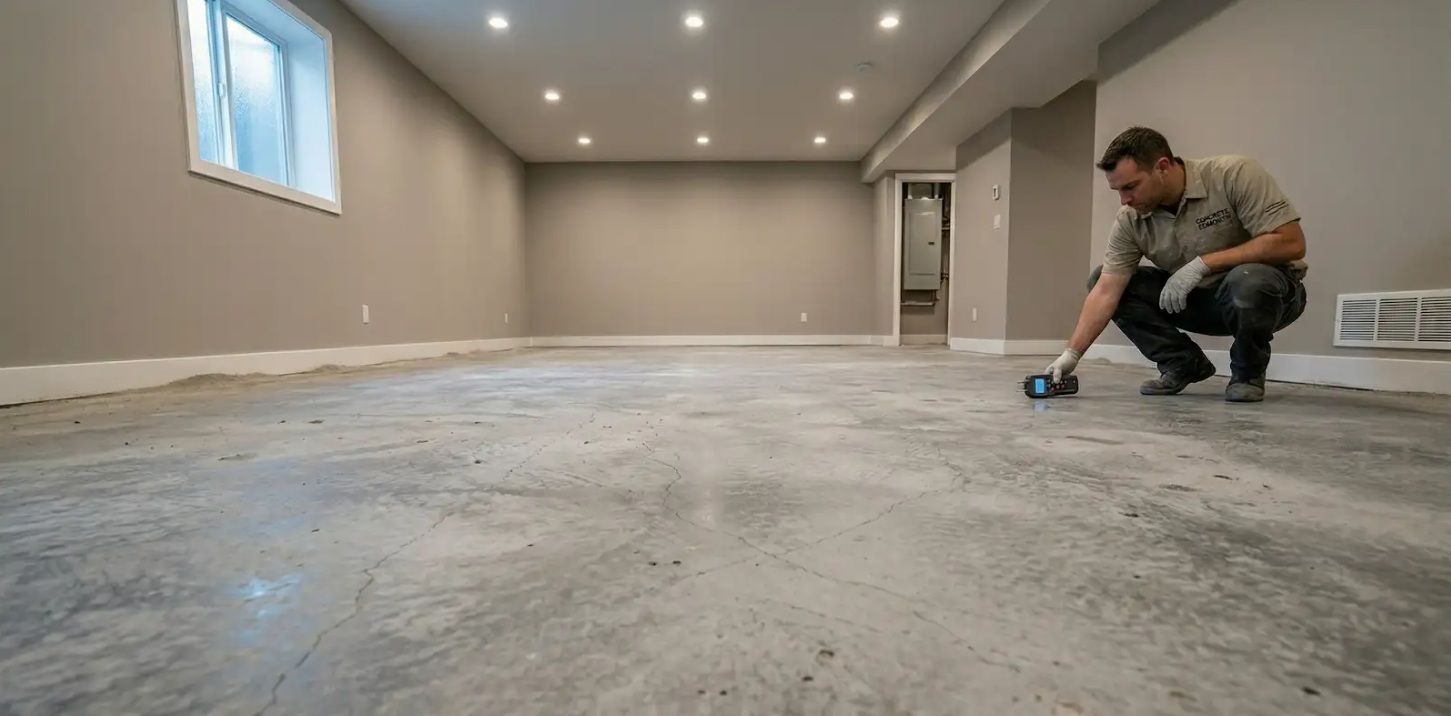
Polished concrete rewards thorough preparation and proper grit sequencing. Any shortcuts taken become evident in the result. A clean slab with no moisture history is a real DIY candidate. Anything more complex benefits from professional eyes first.
Garage Floors 4 Less Edmonton polishes concrete for basements and commercial spaces across Edmonton, St. Albert, Sherwood Park, and Spruce Grove.
Contact us for a free assessment.